
PHP’s November 19, 2026 security releases include two critical bugs worth checking on a web stack. One depends on how your web server reuses connections to PHP-FPM. The other depends on how PHP writes and reads session data. Here’s where I’d look for each one.
A CVE is an identifier for a vulnerability. Remote code execution, or RCE, means an outside party can run code on the server. Both issues covered here score 9.2 out of 10 on the Common Vulnerability Scoring System (CVSS).
CVE-2026-129289 — PHP-FPM connection reuse
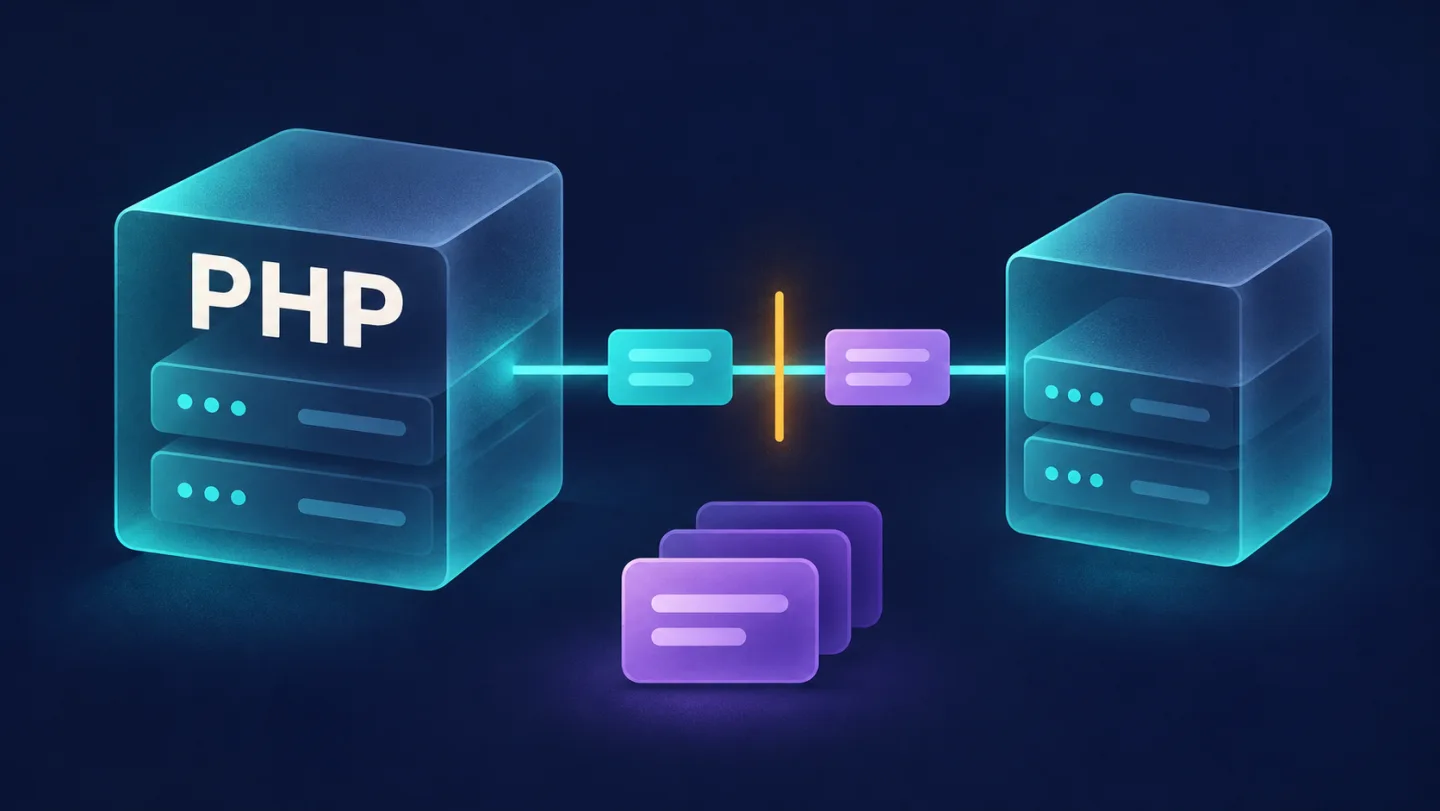
PHP-FPM runs PHP in worker processes and receives requests from a web server over a protocol called FastCGI. In a vulnerable setup, PHP-FPM can start reading another request on a reused connection while bytes from the previous request are still there. It can mistake those leftover bytes for a new request. The result can be a bypass of front-end routing and remote code execution with the worker’s permissions, without a login.
Which setups are affected?
The PHP-FPM attack described in the advisory requires an unpatched runtime, reuse of FastCGI connections between the web server and PHP-FPM, and an application path that opens a request body and leaves some of it unread. Closing the FastCGI connection after each request removes the reuse condition. The connection to check is the one from the web server to PHP-FPM. On managed hosting, the provider may own that setting.
LSAPI, another way to run PHP behind a web server, shares the cleanup bug. It can disrupt later requests on a persistent connection. The advisory demonstrates code execution in PHP-FPM. PHP advisory for CVE-2026-129289
CVE-2026-115560 — Mismatched PHP session formats
A session stores user state across requests. PHP has a built-in feature that writes file upload progress into that session. If PHP writes a session in one format and reads it in another, the reader can misinterpret part of the stored data as a PHP object. If the reading application has suitable classes loaded, restoring the object can lead to code execution.
Which setups are affected?
Check whether PHP’s built-in upload progress is enabled and whether any processes read and write the same session using different formats. That can happen inside one app that changes its session settings at runtime, or across apps that share session storage. Two PHP-FPM pools can still share the same session files.
The patched releases turn built-in session upload progress off by default. An explicit setting can still enable it. If you rely on the feature, check the progress display after updating and make sure every reader and writer of the same sessions agrees on the format. The settings to audit are session.upload_progress.enabled and session.serialize_handler. PHP advisory for CVE-2026-115560
Affected and fixed versions
Both CVEs have the same fix versions across the four PHP branches that received patch releases.
| PHP branch | Unpatched versions | Fixed in |
|---|---|---|
| 8.2 | 8.2.0–8.2.35 | 8.2.36 |
| 8.3 | 8.3.0–8.3.36 | 8.3.37 |
| 8.4 | 8.4.0–8.4.27 | 8.4.28 |
| 8.5 | 8.5.0–8.5.12 | 8.5.13 |
The PHP 8.6.0 stable release shipped the same day with both fixes. Some older unsupported versions are affected as well. For packages from a Linux distribution or hosting provider, check that vendor’s security notice for backported fixes. The November releases also address other CVEs, including issues in PHP-CGI and SOAP. PHP changelog · PHP 8.6.0 release notes in the source tree
What to check in production
- Identify the PHP runtime that handles HTTP traffic.
php -vshows your shell’s PHP version. Check the live application container or hosting panel for the web runtime. - Match each CVE to the relevant setting. Check FastCGI connection reuse for 129289. Check upload progress, shared session storage, and session formats for 115560.
- Patch your current branch. If you’re on 8.4, start with 8.4.28 or your provider’s equivalent. Verify the running version after deployment, then check sign-in and file uploads.
Checking exposure tells you which conditions exist in production. Patching also picks up the other fixes from the same release. If you’re planning a PHP 8.6 upgrade separately, see the PHP 8.6 upgrade checklist.

コメントを残す